|
|
 |
Archive: ART >please note: some links may no longer be active.
via FYTO which, if you don't mind its colorful name, is well-worth exploring as it features many fine images of the ocean
Tilt-Shift Though rarely used until recent years, tilt-shift photography produces very interesting effecst in which the subject in sharp focus, while most everything surrounding it is not (see this article in Wikipedia for much more detail). Given the remarkable capabilities of current generation digital cameras, it is now possible to create this effect in video as well. Here is a really fine example, using Swiss trains as subjects, created by Andi Leemann and Jeri Peier.
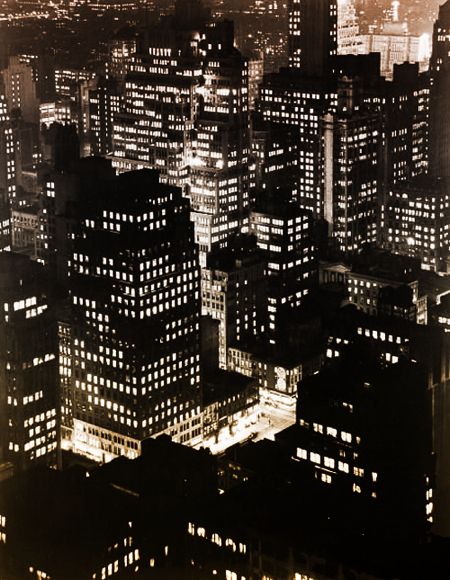
Movie Remakes I don't have the time nor the space to complain about the countless idiocies dotting the pop culture landscape. But I will say that I absoultely abhor the remaking of excellent original films. The most recent outrage is the soon-to-be-released The Taking of Pelham One, Two, Three. It's not that there is anything wrong with actors such as Denzel Washington and John Travolta – it's that the original was so damn good that the new version is certain to be pale in comparison. Which doesn't mean that it won't "succeed" in making money, of course. If you haven't seen the original, directed by Jospeh Sargent, starring Walter Matthau and Robert Shaw, rent it, and don't bother with the shiny new version. Here's a choice snippet, to whet your appetite...
NYC
Poverty Ah you don’t want to, My love, we are not fond, But I don’t want translation: Donald D. Walsh via 3 Quarks Daily
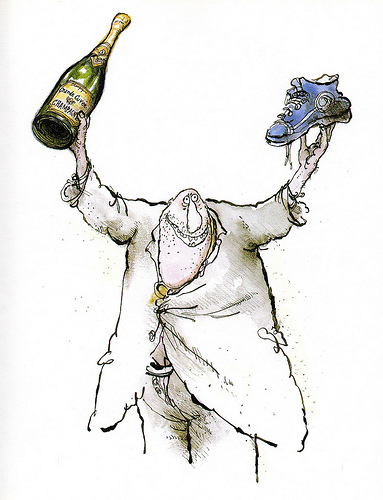
The Illustrated Winespeak
"Coarse but generous" © Ronald Searle much more from the gifted illustrator Ron Searle at BibliOdyssey
In modern recording one of the biggest problems is that you’re in a world of endless possibilities. So I try to close down possibilities early on. I limit choices. I confine people to a small area of manoeuvre. There’s a reason that guitar players invariably produce more interesting music than synthesizer players: you can go through the options on a guitar in about a minute, after that you have to start making aesthetic and stylistic decisions. This computer can contain a thousand synths, each with a thousand sounds. I try to provide constraints for people. — Brian Eno via panopticist
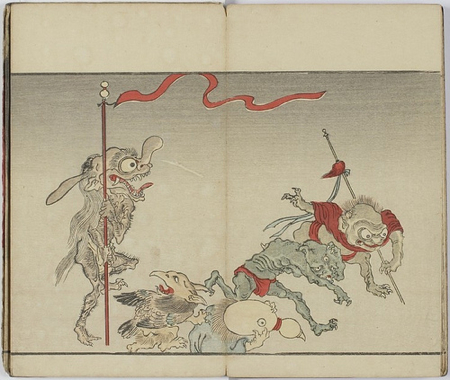
Edo Monsters
From the 'The Pictures of Folkways in Early Modern Ages' Collection in the Nichibunken databases, via Biblio Odyssey
Icebergs
David Burdeny is a photographer whose images of icebergs in the Antarctic are simply stunning. Do visit his site where you can view larger examples.
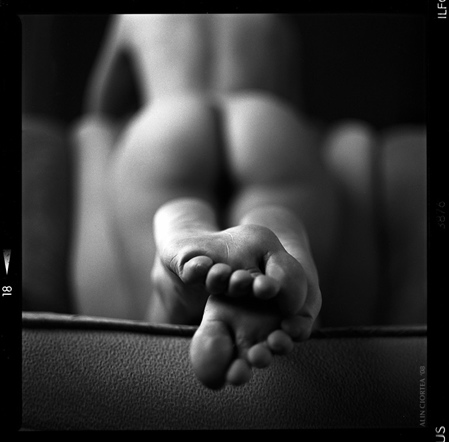
more excellent images from Alin Ciortea (who achieves a particularly fine tonal quality) can be seen at altphotos
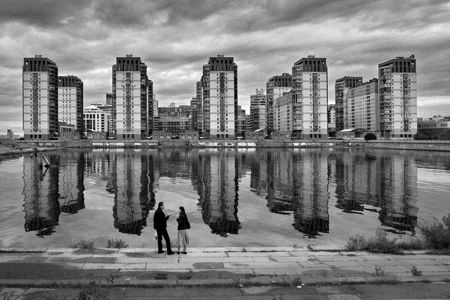
Decrepit, Beautiful, Sad, Wonderful
many more excellent images can be viewed at Life in Russia by Petrosian
more from Benoit P. on his Flickr photostream
The Bright Side From Richard Vague's Delancy Place: In today's excerpt--a tale of optimism to ring in the New Year, from Academy Award-winning screenwriter William Goldman. Here Goldman recounts his first trip as a young boy to Broadway where he attended the Gershwin play Porgy and Bess: "My family went and we sat there and if you don't know the story, it's about this cripple, Porgy, who can't walk, and he gets around on this pathetic goat cart, towed by a scrawny goat, and we're someplace in the Deep South. Porgy is hopelessly in love with Bess, a beauty but weak. Toward the end, Porgy is sent to jail (he saved his friends by murdering the village monster) and while he is there, Bess is wooed by a pusher, Sportin' Life, who, using drugs as a lure, steals her away, takes her to New York City, which is the other end of the universe as far as anyone in this town is concerned. "Porgy gets out of jail, and I am dreading the moment when he finds out Bess is gone. I mean, cripples don't win beauties in this world, not unless they are very rich indeed, and Porgy is a beggar. So he is out of jail and I am so scared for him, his life is over, how is he going to survive his loss, and he chitchats with the villagers and then he says it--where's Bess? "No one wants to answer but finally he finds out - Bess is gone, she is gone forever, gone to New York City." Silence in the theatre. Then Porgy says these three amazing words: " 'Bring my goat.' " William Goldman, Which Lie Did I Tell?: More Adventures in the Screen Trade, Vintage Books, 2001, p. 247
more fine images from Polish photographer Slawek Drozdowski
more very creative tiny plastic people pics in Vincent Bousserez' flickr folder
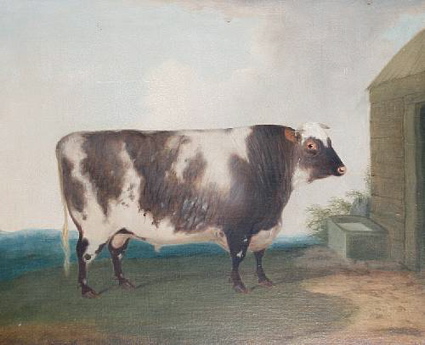
English School, 19th Century to be sold at Bonhams on September 9th (Estimate: £2,000 - 3,000)
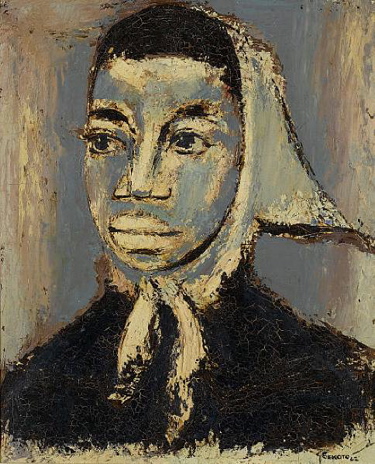
"Blue Head", by South African artist Gerard Sekoto (1913-1993) In 1940, Sekoto became the first black artist to have a painting accepted by the Johannesburg Art Gallery. The above work is to be sold at Bonhams in September (Estimate: £10,000 - 15,000)
The Many Contradictions of Le Courbusier
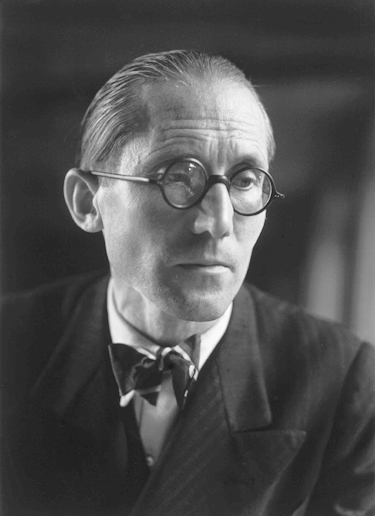
Le Corbusier is difficult to get a hold on. He's still admired, even worshipped, in architectural circles, but practically forgotten everywhere else. He's arguably had more of an influence on the form of the modern world than any other architect - you could even argue there was no modern world before Le Corbusier - but stop someone on the street and ask them to name one of his buildings and you're unlikely to get a correct answer. And if people have heard of him, it's usually in the context of failed 1960s housing estates. All that might change, though. The grandaddy of modernism is up for re-exposure and reappraisal in the coming months. A substantial exhibition, Le Corbusier: The Art of Architecture, moves from its current home in Paris to the crypt of Liverpool's Metropolitan cathedral in October. And this month an enormous new book, Le Corbusier Le Grand, is published, which collects together his diverse achievements for the first time. You couldn't make a book like this about just any architect. Leafing, or rather hefting, through the slab-like tome, it's astounding to see just how much Le Corbusier accomplished. He executed more than 300 designs on every scale, from small huts to entire cities (though only 78 of those designs were ultimately built). He also wrote 34 books, gave countless speeches, lectures and interviews, drew, painted and sculpted, designed furniture, ran businesses, travelled the world, had love affairs, co-edited a magazine, invented his own system of proportions and wrote to his mother at least once a week. Where on earth, you wonder, did he find the time? Beyond the architecture, Le Corbusier Le Grand reveals a great deal about the man himself. There are some surprisingly pornographic sketches - clearly not designed to be seen by his clients (or, one suspects, his wife Yvonne). There is ample proof of his enthusiasm for modernity: there he is posing inside a mocked-up biplane in a 1920s photographer's studio; here's a souvenir from his transatlantic flight to Rio de Janeiro aboard the Graf Zeppelin, and a postcard of a Lockheed Constellation on which he has doodled himself sitting on the wing. There are also snaps of him with the great and good, from Albert Einstein to Josephine Baker (contrary to rumours, it's unlikely they had an affair). And there are tender sketches of his father, mother and wife on their deathbeds. It all points to a life lived enviably fully. Perhaps this is one of the reasons Le Corbusier is not as publicly recognisable as he should be: he simply did too much. Rather than sticking to a single, easily identifiable style, his work continually evolved. And, as the man who set the stage for modern architecture, his buildings have all but been drowned out by the noise of countless diluted imitations. Compared to the work of today's celebrity architects like Frank Gehry or Norman Foster or Zaha Hadid, much of Le Corbusier's architecture is practically anonymous. He didn't build flamboyant art galleries or concert halls or triumphant skyscrapers. Many of his defining works were private residences for wealthy patrons and his grandest schemes were never built at all. But his influence is detectable in the DNA of virtually everyone who came after him. By all accounts, as a person he was shy, hesitant, even under-confident, but - another contradiction - he was a canny self-promoter. His public image was as cultivated as that of Ziggy Stardust. He had the trademark look: dapper suit, spectacles and bowtie, which became the standard uniform for the profession. Especially the glasses. Thick, owl-eyed, horn-rimmed eyewear was adopted by many an architect who should have known better. more from Steve Rose in The Guardian (U.K.)
Too Cool
The most complex, "mind-boggling" crop circle ever to be seen in Britain has been discovered in a barley field in Wiltshire. The formation, measuring 150ft in diameter, is apparently a coded image representing the first 10 digits, 3.141592654, of pi. It is has appeared in a field near Barbury Castle, an iron-age hill fort above Wroughton, Wilts, and has been described by astrophysicists as "mind-boggling". Michael Reed, an astrophysicist, said: "The tenth digit has even been correctly rounded up. The little dot near the centre is the decimal point. more from The Telegraph (U.K.)
Versunken
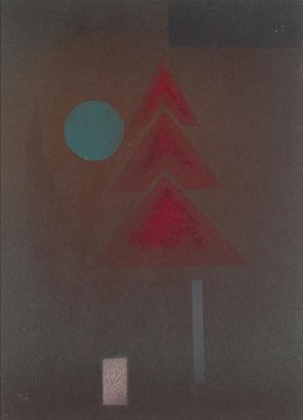
or "almost submerged"; gouache on paper, by Wassily Kandinsky (1866-1944) estimate 90,000 – 120,000 GBP to be sold in London at Sotheby's on June 26th
Unlike Love In today's excerpt – Canadian author Margaret Atwood writes of the cruelty of little girls to each other in her semi-autobiographical novel on cruelty among women – Cat's Eye. Here we find nine-year-old Elaine with her new best friends, led by Cordelia: "On the window ledge beside mine, Cordelia and Grace and Carol are sitting, jammed in together, whispering and giggling. I have to sit on a window ledge by myself because they aren't speaking to me. It's something I said wrong, but I don't know what it is because they won't tell me. Cordelia says it will be better for me to think back over everything I've said today and try to pick out the wrong thing. That way I will learn not to say such a thing again. When I've guessed the right answer, they will speak to me again. All of this is for my own good, because they are my best friends and they want to help me improve. ... What did I say wrong? I can't remember having said anything different from what I would ordinarily say. ... "[Later] I stand outside the closed door of Cordelia's room. Cordelia, Grace and Carol are inside. They're having a meeting. The meeting is about me. I am just not measuring up, although they are giving me every chance. I will have to do better. But better at what? ... "[Several days later] they are on the school bus, where Cordelia stands close beside and whispers in my ear: 'Stand up straight! People are looking!' Carol is in my classroom, and it's her job to report to Cordelia what I do and say all day. They're there at recess and in the cellar at lunchtime. They comment on the kind of lunch I have, how I hold my sandwich, how I chew. On the way home from school I have to walk in front of them, or behind. In front is worse because they talk about how I'm walking, how I look from behind. 'Don't hunch over,' says Cordelia. 'Don't move your arms like that.' ... "But Cordelia doesn't do these things or have this power over me because she's my enemy. ... Cordelia is my friend. She likes me, she wants to help me, they all do. They are my friends, my girl friends, my best friends. I have never had any before and I'm terrified of losing them. I want to please. "Hatred would have been easier. With hatred, I would have known what to do. Hatred is clear, metallic, one-handed, unwavering; unlike love." Margaret Atwood, Cat's Eye, Anchor, Copyright 1988 by O.W. Toad, Ltd., pp. 127-132. via DelancyPlace
A Blind Woman She had turned her face up into The light trickled down her forehead into the neck of her sweatshirt Her brown shoes splashed on a circus wagon rolling before her and she walked fast behind it, through the bars, poking and prodding, via 3 Quarks Daily
Afraid So A poem by Jeanne Marie Beaumont Is it starting to rain? via Amitava Kumar
Floyd on Dylan Chris Floyd, whose work I've excerpted a number of times over the years, writes almost exclusively about politics, and does so in an exceptionally pungent and straightforward manner. So his recent post on Bob Dylan, who just turned 67, is not only excellent, but also a interesting contrast to Floyd's more typical work. You can follow Dylan through many doors, into many realms: the disordered sensuality of Symbolist poetry, the high bohemia and low comedy of the Beats and Brecht, the guilt-ridden, God-yearning psalms of King David, the Gospel road of Jesus Christ, the shiv-sharp romance of Bogart and Bacall. There's Emerson in there, too, Keats, Whitman, even Rilke if you look hard enough: fodder for a thousand footnotes, signposts to a hundred sources of further enlightenment. But if you go far enough with Dylan, he'll always lead you back to the old music. This is the foundation, the deepest roots of his art, of his power. For me, as for so many people, he was the spirit guide to this other world, this vanished heritage. He has somehow – well, not just "somehow," but through hard work and endless absorption – managed to keep the tradition alive. Not as a museum piece, not like a zoo animal, but as a free, thriving, unpredictable beast, still on the prowl, still extending its range. do read the full piece, even if you are not a hard-core Dylan fan
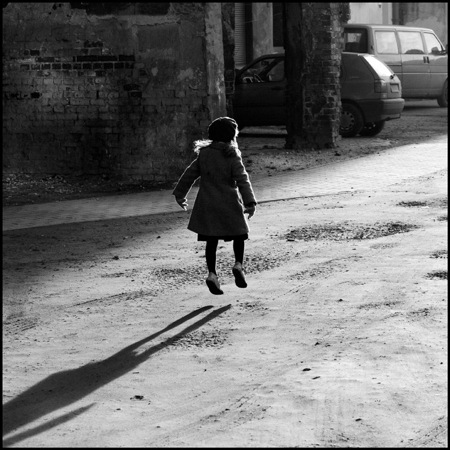
Wheeee!
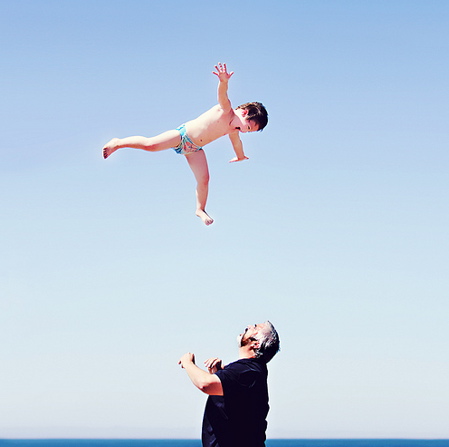
via inkyblack's fine photostream
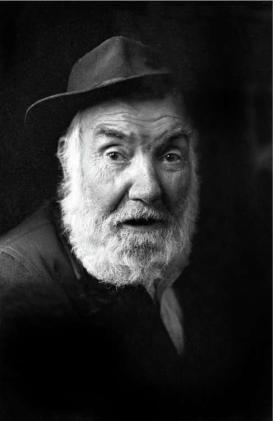
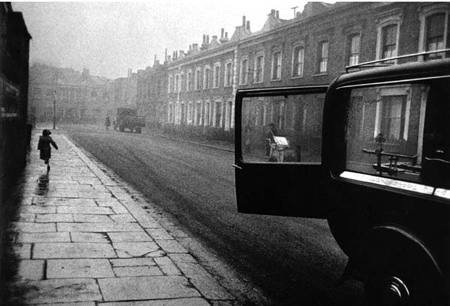
Wales, Years Ago In the early 1970s, Robert Haines, as a young photographer, returned to his roots to document life in the mining communities of the Welsh Valleys. Unpublished for 35 years, the results offer a fascinating glimpse of a vanished past.
Old Man Jenkins - Jenkins had very bad legs and would often be seen shuffling from his home on Castle Street to Ye Olde Express pub in his slippers Be sure to view the many moving photos which accompany this article in The Independent (U.K.)
An Unsentimental Journey
Robert Frank, the photographic master, the last human being it’s been said to discover anything new behind a viewfinder, collapsed in a filthy Chinese soup shop and no one had thought to bring along a camera. He looked like something from a Kandinsky painting—slumped between a wall and stool—sea green, limp, limbs akimbo. It would have made a good, unsentimental picture: a dead man and a bowl of soup. Frank would have liked it. The lighting was right. The shop was hidden away in the shadow of a Confucian temple in the ancient walled city of Pingyao, China, about 450 miles southwest of Beijing, where Frank had come as an honored guest of a photography festival. The city is a photographic dream, a 2,700-year-old dollhouse of clay brick, camels, coal embers, and carved cornices. So many photographers had descended upon the place that a picture of a man taking a picture of a man taking a picture of a man taking a picture of a picture was considered interesting enough and yet nobody at the dead man’s table had so much as a sketching tablet. Read the rest of Charlie LeDuff's interesting piece in Vanity Fair (via 3 Quarks Daily)
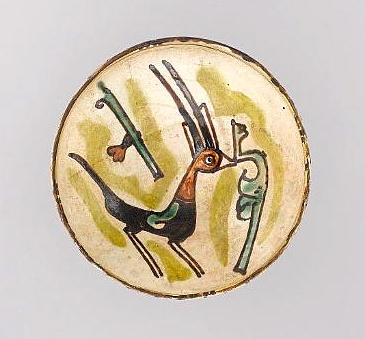
Lot No: 165, Sale 16221 at Bonham's on April 10; A rare Samanid slip-painted pottery Bowl Persia or East Transoxiana, 10th Century Estimate: £4,000 - 6,000
More ART? click here! •••
|
|
books
daily reads
film
favorite posts pinter on politicians' language
music
art
archives
|
| ©2005 Tony. All rights reserved. | Website
designed by JSVisuals.com |