|
|
 |
Peak oil oppositional disorder: neurosis or psychosis? The latest version of the Diagnostic and Statistical Manual of Mental Disorders (DSM) has grown to include 297 disorders, but it seems that there is always room for one more. Richard Heinberg recently published an article that addresses various recent claims that Peak Oil is no longer a concern. His term for the phenomenon is “peak denial.” It sounds good, and dovetails nicely with Richard's overall theme of “peak everything.” It's a thoughtful piece that does a thorough job of exposing the surreal nature of the optimists' projections, and I have no issues with his argument. I do, however, have an issue with his terminology. First, since denial does not happen to be a nonrenewable resource with a characterizable depletion profile, its peak, should we detect one, is not particularly meaningful, because it could just as easily peak again tomorrow and then again next century. Second, I suspect that “denial” is no longer the right word to describe the social phenomenon we are currently observing. I think that Ugo Bardi pointed us in the right direction: in his article reacting to George Monbiot's assertion "We were wrong about peak oil, there is enough to fry us all," Ugo used Monbiot's approach to Peak Oil using another word: “delusion.” If you feel that the distinction between denial and delusion is just a minor, innocuous terminological difference—a gratuitous splitting of hairs on my part—then pardon me while I whip out my Sigmund Freud: in The Loss of Reality in Neurosis and Psychosis [1924] he wrote the following: “Neurosis does not disavow the reality, it ignores it; psychosis disavows it and tries to replace it.” [p. 185] What psychosis replaces reality with is delusion. Let's take this one step at a time. Denial is where you know full well that something exists (e.g., there is a finite amount of economically recoverable oil and we have already burned about half of it) but refuse to consider it as important. Denial is symptomatic of neurosis. Neurotics are not considered particularly dangerous; they can be quite annoying, and they can sometimes pose a threat to themselves, but they are, in general, not considered to pose a threat to society. They can also be quite charming: Woody Allen parlayed his neuroses into a successful acting/directing career. (In German the title of his film Annie Hall is Stadtneurotiker—“urban neurotic.”) Delusion, on the other hand, is symptomatic of psychosis. Now, when was the last you ran across a charming, urbane, popular, successful psychotic? Back to Freud: old Sigmund distinguishes two types of thinking: there is secondary process thinking—the good kind—the domain of the well-adjusted, socialized self, grounded in consensual reality, reasonableness, rationality and logic. And then there is primary, or archaic process thinking—the bad kind—the product of obsession, compulsion, hallucination and... here we go... delusion. The path that leads from neurosis to psychosis is a regression toward a more primitive, archaic, infantile self. Take your typical neurotic (refuses to face Peak Oil, spouts gibberish about it when pressed), put that neurotic through a terrible, ego-destroying crisis, and that individual may regress and lapse into psychosis. What happens to individuals also happens to entire societies. Take a neurotic Peak Oil-denying industrial civilization, put it through a terrible global financial crisis, tell it that economic growth is over forever, and what you get a psychotic, delusional industrial civilization. In Civilization and its Discontents [1930] Freud wrote of the capacity of delusions to propel an entire culture toward disintegration in a maelstrom of violence, and in Constructions in Analysis [1937] he pointed out that once delusional thinking permeates an entire culture, including its religion and its politics, that culture becomes inaccessible to logical argument. Delusion is a sort of tyranny—internal in the case of a sick individual, external in the case of a sick culture—that traps reality within specific images, precluding any possibility of self-understanding or objectivity. This is a rather important point to take on board for those who continue to patiently argue the case for Peak Oil: to a psychotic, anyone who disagrees with her is automatically the enemy, and, since psychotics create their own reality, it is just a tiny step for her to then declare that the Peak Oil movement actually caused Peak Oil and is therefore to blame. It is quite typical for a psychotic to project delusions onto others in an effort to make them act as parts of her own enraged, uncontrollable self, because identifying the threat as her own self leads to an uncontrollable panic. This type of projection is a psychotic's main means to exercise power over others. Now, let's keep in mind that confronting a delusional mob is not the same as confronting a delusional patient in a psych ward, where there is a red panic button on the wall that you can push at any time, and nurses will rush in to restrain and sedate the patient. We have to be careful: when a psychotic society acts out, there is no-one to restrain it. Let us look at the progression. The chant “Drill, baby drill!” at Sarah Palin's political rallies was a denialist, neurotic response to Peak Oil—an obsessive-compulsive reaction to the news that oil is running out. Neurotics often develop rituals which, though ineffectual in any practical sense, comfort them and temporarily reduce their level of anxiety. A typical example is compulsive hand-washing in an OCD-sufferer. And indeed we went on to see a ridiculous amount of drilling activity, most of it not particularly productive. But then something quite different came along: subsequent pronouncements that the US is about to become energy-independent are of an entirely different nature. These are born of delusions of omnipotence which are very common in psychotic patients. Likewise, psychotic obsessions often have physical mutilation as their objective, using the physical body as a surface on which to express anxiety and dread. It is something less than a metaphor to say that for a society, its body is the land on which it lives. Is fracking (hydraulic fracturing), which is ineffectual in any practical sense, but causes ghastly environmental and financial damage, not just such a psychotic self-mutilation? Here is another instance of the same progression: the terrorist attacks of 9/11 initially produced a largely neurotic response. One instance of it is what's often been described as “security theater” carried out by the Transportation Safety Administration at airports in the US. The screening system is sufficiently porous for anyone who cares to do so to smuggle through a weapon and even a bomb, but everyone is forced to submit to a humiliating charade with sexual overtones (groping). The entire process is an institutionalized obsessive-compulsive coping mechanism: an attempt to control the society's anxiety level through nonsensical rituals. But a few years later a very different behavior evolved: endless “surgical” drone aircraft strikes in areas of Afghanistan and Pakistan thought to be controlled by the Taleban. The idea is to exterminate the enemy through physical assassination. From a rational perspective the strategy is nonsense: the Taleban, who are considered the enemy, are predominantly ethnic Pashtuns; the Pashtun code of honor,Pashtunwali, requires family members to avenge all murders (although payment of restitution is also acceptable); there are some 40 million Pashtuns. Every time a drone kills a Pashtun, another Pashtun is forced to join the Taleban and try to kill an American. If the goal is to minimize American deaths, then the winning strategy is obvious: Americans should stop killing Pashtuns. But if your country has shifted gears from neurosis to psychosis, then rational arguments no longer apply because in your own mind you are now omnipotent and must surgically excise the Other, or face uncontrollable panic. One more symptom: the psychotic condition is often accompanied by a sense of unlimited entitlement, and, surely enough, one thing I consistently hear from Americans is: “All we have to do is keep printing dollars because nobody can stop us.” more from the excellent Dmitry Orlov at energybulletin.net
Ellen Cantarow: The new eco-devastation in rural America When workers drilling tunnels at Gauley Bridge, West Virginia, began to die, Union Carbide had an answer. It hadn’t been taking adequate precautions against the inhalation of silica dust, a known danger to workers since the days of ancient Greece. Instead, in many cases, a company doctor would simply tell the families of the workers that they had died of “tunnelitis,” and a local undertaker would be paid $50 to dispose of each corpse. A few years later, in 1935, a congressional subcommittee discovered that approximately 700 workers had perished while drilling through Hawk’s Nest Mountain, many of them buried in unmarked graves at the side of the road just outside the tunnel. The subcommittee concluded that Union Carbide’s project had been accomplished through a “grave and inhuman disregard of all considerations for the health, lives and future of the employees.” Despite the “Hawk’s Nest Incident” and thousands of Depression-era lawsuits against foundries, mines, and construction companies, silicosis never disappeared. In the decades since, as TomDispatch authors David Rosner and Jerry Markowitz have repeatedly demonstrated, industry worked tirelessly to label silicosis a “disease of the past,” even while ensuring that it would continue to be a disease of the present. By the late 1990s, the Columbia University researchers found that from New York to California, from Texas all the way back to West Virginia, millions of workers in foundries, shipyards, mines, and oil refineries, among other industries, were endangered by silica dust. Today, there’s a new silicosis scare on the horizon and a new eco-nightmare brewing in the far corners of rural America. Like the Hawk’s Nest disaster it has flown under the radar — until now. much more at Tom Dispatch
Drone filmmaker denied visa Muhammad Danish Qasim is a Pakistani student at Iqra University’s Media Science and is also a filmmaker. This year, Qasim released a short film entitled The Other Side, a 20-minute narrative that “revolves around the idea of assessing social, psychological and economical effects of drones on the people in tribal areas of Pakistan.” A two-minute video trailer of the film is embedded below. The Express Tribune provided this summary of the film, including an interview with Qasim: The Other Side revolves around a school-going child in Miranshah, the capital of North Waziristan. The child’s neighborhood gets bombed after the people of the region are suspected for some notorious activities. He ends up losing all of his loved ones during the bombing and later becomes part of an established terrorists group who exploit his loss and innocence for their own interests. On the reasons for picking such a sensitive topic, the film-maker said, “Most of the films being made right now are based on social issues, so we picked up an issue of international importance which is the abrogation of our national space by foreign countries.” When asked how this film on terrorism will be different from all the others that have been released since 9/11, he said, “The film takes the audience very close to the damage caused by drone attacks. I have tried my best to connect all the dots that lead to a drone attack and have shot the prevailing aftermath of such attacks in a very realistic and raw manner.” In particular, “the film identifies the problems faced by families who have become victims of drone missiles, and it unearths the line of action which terrorist groups adopt to use victimised families for their vested interests.” In other words, it depicts the tragedy of civilian deaths, and documents how those deaths are then successfully exploited by actual Terrorists for recruitment purposes. We can’t have the U.S. public learning about any of that. In April, Qasim was selected as the winner of the Audience Award for Best International Film at the 2012 National Film Festival For Talented Youth, held annually in Seattle, Washington. Qasim, however, along with his co-producers, were prevented from traveling to the U.S. to accept their award and showcase their film because their request for a visa to travel to the U.S. was denied. The Tribune reported: “Despite being chosen for the award, the filmmakers were unable to attend the award ceremony as their visa applications were rejected twice. ’If we got the visa then it would have been easy for us to frame our point of view in front of the other selected youth filmmakers,’ Qasim said.” And: “I believe the most probable reason for the visa denial was the sensitive subject of my film,” says Qasim. He recalls that when the visa officer asked about the subject matter of the film, he suggested making changes in the letter issued by his University upon hearing that the film dealt with terrorism and drone attacks. “Although I made the changes to the letter according to the visa officer’s recommendation, they still rejected the visa and did not disclose the reason for it,” says a disappointed Qasim. According to Qasim, “NFFTY is considered to be the biggest event for young film-makers of the world. Film schools as well as potential Hollywood producers attend the event in order to interact with young, talented film-makers. I’m disappointed that my team, especially my crew members Atiqullah, Ali Raza Mukhtar Ali and Waqas Waheed Awan, who made the film possible with their hard work and support, missed out on a major opportunity to represent Pakistan on an international forum.” Although it’s not proven why the visa was denied — the U.S. government, needless to say, refuses to comment on visa denials — this case is similar to that of Shahzad Akbar, a Pakistani lawyer who had sued the CIA on behalf of civilian drone victims and was also denied a visa to travel to the U.S. to attend last month’s Drone Summit in Washington; the Obama administration relented and permitted him to travel to the U.S. only once a serious outcry arose. The Bush administration also routinely excluded Muslim critics of U.S. foreign policy from entering the U.S. Banning filmmakers, lawyers, political activists, and scholars from entering your country out of fear of their criticisms is the behavior of an insecure, oppressive nation. It’s also natural behavior for political leaders eager to maintain an impenetrable wall of secrecy around their conduct. more from Glenn Greenwald at Salon.com
Crime boasting for profit On December 7, 2007, The New York Times reported that the CIA “in 2005 destroyed at least two videotapes documenting the interrogation of two Qaeda operatives in the agency’s custody, a step it took in the midst of Congressional and legal scrutiny about its secret detention program.” Documents obtained when the ACLU asked a federal judge to hold the CIA in contempt of court — for destruction of evidence which that judge had ordered be produced — subsequently revealed that the agency had actually “destroyed 92 videotapes of terror-suspect interrogations.” The videotapes recorded interrogations of detainees who were waterboarded and otherwise tortured. The original NYT article, by Mark Mazzetti, reported that “the decision to destroy the tapes was made by Jose A. Rodriguez Jr., who was the head of the Directorate of Operations, the agency’s clandestine service” (the NYT later reported that some White House officials had participated in the deliberations and even advocated the tapes’ destruction). Destruction of these tapes was so controversial because it seemed so obviously illegal. At the time the destruction order was issued, numerous federal courts — as well as the 9/11 Commission — had ordered the U.S. Government to preserve and disclose all evidence relating to interrogations of Al Qaeda and 9/11 suspects. Purposely destroying evidence relevant to legal proceedings is called “obstruction of justice.” Destroying evidence which courts and binding tribunals (such as the 9/11 Commission) have ordered to be preserved is called “contempt of court.” There are many people who have been harshly punished, including some sitting right now in prison, for committing those crimes in far less flagrant ways than was done here. In fact, so glaring was the lawbreaking that the co-Chairmen of the 9/11 Commission — the mild-mannered, consummate establishmentarians Lee Hamilton and Thomas Kean — wrote a New York Times Op-Ed pointedly accusing the CIA of “obstruction” (“Those who knew about those videotapes — and did not tell us about them — obstructed our investigation”). In 2008, Attorney General Michael Mukasey appointed a Special Prosecutor to determine if criminal charges should be filed. When I was writing my last book about the legal immunity bestowed on political elites even for egregious crimes, I actually expected that Rodriguez would be indicted and that his indictment would be an exception to the rule of elite immunity which I was documenting. As I wrote in my book, “even our political class, I thought, couldn’t allow lawbreaking this brazen to go entirely unpunished.” But I was quite wrong about that. In November, 2010, the Obama DOJ — consistent with its steadfast shielding of Bush-era criminals from all forms of accountability — announced that the investigation would be closed without any charges being filed. Needless to say — given how subservient federal judges are to the Executive Branch in the post-9/11 era — the federal judge who had ordered the CIA to preserve and produce any such videotapes, Alvin Hellerstein, refused even to hold the CIA in contempt for deliberately disregarding his own order. Instead, Hellerstein — who, like so many federal judges, spent his whole career before joining the bench as a partner for decades in a large corporate law firm serving institutional power — reasoned that punishment for the CIA was unnecessary because, as he put it, new rules issued by the CIA “should lead to greater accountability within the agency and prevent another episode like the videotapes’ destruction.” In other words, as I put it in a Guardian Op-Ed about Hellerstein’s CIA-protecting decision: the CIA has promised not to do this again, so they shouldn’t be punished for the crimes they committed. Aside from how difficult it is, given the agency’s history, to make that claim without triggering a global laughing fit, it is also grounded in a principle of leniency rarely applied to ordinary citizens. After all, most criminal defendants caught up in the life-destroying hell of a federal prosecution are quite unlikely to repeat their crimes in the future, yet that fact is no bar to punishing them for the illegal acts they already committed. But the CIA, of course, operates under a different justice system: one in which they are free to deliberately break laws and violate court orders with impunity. much more from Glenn Greenwald at Salon.com
World’s Apex Bully Leads World Into Lawlessness The US government pretends to live under the rule of law, to respect human rights, and to provide freedom and democracy to citizens. Washington’s pretense and the stark reality are diametrically opposed. US government officials routinely criticize other governments for being undemocratic and for violating human rights. Yet, no other country except Israel sends bombs, missiles, and drones into sovereign countries to murder civilian populations. The torture prisons of Abu Gahraib, Guantanamo, and CIA secret rendition sites are the contributions of the Bush/Obama regimes to human rights. Washington violates the human rights of its own citizens. Washington has suspended the civil liberties guaranteed in the US Constitution and declared its intention to detain US citizens indefinitely without due process of law. President Obama has announced that he, at his discretion, can murder US citizens whom he regards as a threat to the US. Congress did not respond to these extraordinary announcements with impeachment proceedings. There was no uproar from the federal courts, law schools, or bar associations. Glenn Greenwald reports that the Department of Homeland Security harasses journalists who refuse to be presstitutes, and we have seen videos of the brutal police oppression of peaceful OWS protestors. Chris Floyd has described on CounterPunch the torture-perverts who rule the US. Now Washington is forcing as much of the world as it can to overthrow international treaties and international law. Washington has issued a ukase that its word alone is international law. Any country, except those who receive Washington’s dispensation, that engages in trade with Iran or purchases Iran’s oil will be sanctioned by the US. These countries will be cut off from US markets, and their banking systems will not be able to use banks that process international payments. In other words, Washington’s “sanctions against Iran” apply not to Iran but to countries that defy Washington and meet their energy needs with Iranian oil. According to the Christian Science Monitor, so far Washington has granted special privileges to Japan and 10 European Union countries to continue purchasing Iranian oil. Requiring countries to shut down their economies in order to comply with Washington’s vendetta against Iran, a vendetta that has been ongoing ever since the Iranians overthrew the Washington-installed puppet, the Shah of Iran, more than three decades ago, was more than Washington could get away with. Washington has permitted Japan to keep importing between 78-85 per cent of its normal oil imports from Iran. Washington’s dispensations, however, are arbitrary. Dispensations have not been granted to China, India, Turkey, and South Korea. India and China are the largest importers of Iranian oil, and Turkey and South Korea are among the top ten importers. Before looking at possible unintended consequences of Washington’s vendetta against Iran, what is Washington’s case against Iran? Frankly, Washington has no case. It is the hoax of “weapons of mass destruction” all over again. Iran, unlike Israel, signed the non-proliferation treaty. All countries that sign the treaty have the right to nuclear energy. Washington claims that Iran is violating the treaty by developing a nuclear weapon. There is no evidence whatsoever for Washington’s assertion. Washington’s own 16 intelligence agencies are unanimous that Iran has had no nuclear weapons program since 2003. Moreover, the International Atomic Energy Agency’s weapons inspectors are in Iran and have reported consistently that there is no diversion of nuclear material from the energy program to a weapons program. On the rare occasion when Washington is reminded of the facts, Washington makes a different case. Washington asserts that Iran’s rights under the non-proliferation treaty notwithstanding, Iran cannot have a nuclear energy program, because Iran would then have learned enough to be able at some future time to make a bomb. The world’s apex bully has unilaterally decided that the possibility that Iran might one day decide to make a nuke is too great a risk to take. It is better, Washington says, to drive up the oil price, disrupt the world economy, violate international law, and risk a major war than to have to worry that a future Iranian government will make a nuclear weapon. This is the Jeremy Bentham tyrannical approach to law that was repudiated by the Anglo-American legal system. more from Paul Craig Roberts at Counterpunch
Me: You taught yourself to play guitar? A: In college. I wanted to impress girls. Me: Ah. You had an ulterior motive. A: Not really. Me: But you learned guitar specifically to impress girls. A: In college, “wanting to impress girls” is the primary motive for learning guitar. An example of an ulterior motive would be, “and I thought I’d enjoy playing guitar”. via Defective Yeti
watch Minka full screen at vimeo
New Study: GMO’s Bt protein toxic to human cells Insecticidal Bt toxins such as those produced in genetically engineered plants can be detrimental to human cells. This is a result of recent research led by researchers at the University of Caen (France). Their experiments showed that toxins produced in, for example, the genetically engineered maize MON810, can significantly impact the viability of human cells. The effects were observed with relatively high concentrations of the toxins, nevertheless there is cause for concern. According to companies like Monsanto, which produces genetically engineered maize with these toxins, the toxins are supposed to be active only against particular insects and should have no effect on mammals and humans at all. For the first time, experiments have now shown that they can have an effect on human cells. These kinds of investigations are not a requirement for risk assessment in Europe or in any other region. Another finding of the researchers concerns a herbicide formulation sold under the brand name Roundup. Massive amounts of this herbicide are sprayed on genetically engineered soybean crops and its residues can be found in food and feed. According to the new publication, even extremely low dosages of Roundup (glyphosate formulations) can damage human cells. These findings are in accordance with several other investigations highlighting unexpected health risks associated with glyphosate preparations. “We were very much surprised by our findings. Until now, it has been thought almost impossible for Bt proteins to be toxic to human cells. Now further investigations have to be conducted to find out how these toxins impact the cells and if combinatorial effects with other compounds in the food and feed chain have to be taken into account,” says Gilles-Eric Séralini from the University of Caen, who supervised the experiments. “In conclusion, these experiments show that the risks of Bt toxins and of Roundup have been underestimated.” Bt toxins and tolerance to herbicides are broadly used in genetically engineered plants. Bt proteins only naturally occur in soil bacteria. By introducing the modified toxin gene into the plants, the structure of the toxins is modified and may thereby cause selectivity to be changed. The content of the proteins within the plants is highly variable. Many genetically engineered plants contain several Bt toxins at the same time. For example, SmartStax produces six different Bt toxins and therefore has a higher overall content of the proteins. In addition, it was made tolerant to herbicides. So far, there has been no investigation of the combinatorial effects of these toxins and residues from spraying, or their potential risks for human health, which was considered unlikely. The researchers have now shown that interactivity does occur. Under the specific conditions of their experiment, the modified Bt toxin lowered the toxicity of Roundup. Further investigations are necessary to examine other potential combinatorial effects under varying conditions. “These results are pretty worrying. Risk assessment requirements for genetically engineered plants and pesticides need to be rigidly enforced. In the light of these findings, we think that the commercialization of these plants is not in accordance with EU regulations”, says Christoph Then at Testbiotech. more from Frédérique Baudouin at Food Freedom
Do Drones Undermine Democracy? IN democracies like ours, there have always been deep bonds between the public and its wars. Citizens have historically participated in decisions to take military action, through their elected representatives, helping to ensure broad support for wars and a willingness to share the costs, both human and economic, of enduring them. In America, our Constitution explicitly divided the president’s role as commander in chief in war from Congress’s role in declaring war. Yet these links and this division of labor are now under siege as a result of a technology that our founding fathers never could have imagined. Just 10 years ago, the idea of using armed robots in war was the stuff of Hollywood fantasy. Today, the United States military has more than 7,000 unmanned aerial systems, popularly called drones. There are 12,000 more on the ground. Last year, they carried out hundreds of strikes — both covert and overt — in six countries, transforming the way our democracy deliberates and engages in what we used to think of as war. We don’t have a draft anymore; less than 0.5 percent of Americans over 18 serve in the active-duty military. We do not declare war anymore; the last time Congress actually did so was in 1942 — against Bulgaria, Hungary and Romania. We don’t buy war bonds or pay war taxes anymore. During World War II, 85 million Americans purchased war bonds that brought the government $185 billion; in the last decade, we bought none and instead gave the richest 5 percent of Americans a tax break. And now we possess a technology that removes the last political barriers to war. The strongest appeal of unmanned systems is that we don’t have to send someone’s son or daughter into harm’s way. But when politicians can avoid the political consequences of the condolence letter — and the impact that military casualties have on voters and on the news media — they no longer treat the previously weighty matters of war and peace the same way. more from Peter W. Singer in The NY Times
Real Journalism
Nixing Newt I don’t claim infallibility, and a good thing too, because when it comes to bad calls, I’ve made some beauts, to paraphrase Mayor Jimmy Walker. The most recent was when someone on Twitter summoned the possibility of Newt Gingrich resurging in the Republican primaries and I tweeted a terse “No.” To me it was beyond the realm of possibility, just another gaseous emission from the punditry (which is craving a horse race). How wrong I was. On this crisp Monday morning in December, the Pillsbury Doughboy of political promiscuity is enjoying the “big mo” while Mitt Romney is getting the blinky look of once-grinny confidence caving into panic. Clearly Romney no more seriously entertained the possibility of Gingrich’s bounceback than I did, and we were both wrong, though the consequences for Mitt are a shade higher than they are for me, sitting in bright obscurity at whatever diner counter will have me. Allow me to say this in my puny defence, however. One reason I’m such a wayward prognosticator of rightwing trends is that I’m incapable of blacking out enough neural sectors to see the world through reptilian-brained eyes, a prerequisite for any true channeling of the mean resentments and implanted fears that drive hardcore conservatives. read the rest of James Wolcott's superb piece at Vanity Fair
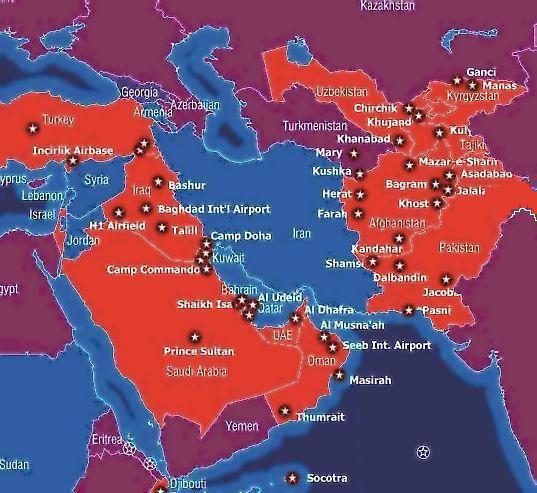
Iran: The Great Threat Each star is a US base. But just to be clear, Iran is the one that is threatening us.
via Juan Cole
Why I oppose Financial Stability Financial Stability became a topic in the late 1990s, at a time of peak laxity in international financial supervision. The same minds which promoted the Financial Stability Forum (now the Financial Stability Board) also crafted the deeply flawed and destructive Basel II. I have never understood why Financial Stability should be an objective of public policy. Desirable, measurable outcomes of benefit to the public should be the objectives of public policy. Stability is a silly and impractical goal in a capitalist economy. Success and failure of competitive firms are the basis for economic progress, capital allocation and market pricing. Capitalism requires recognition of failure, and failure always causes economic loss and some instability as past assumptions are re-examined and re-assessed more objectively in light of current painful reality. The management of failure can contribute to better future outcomes, but only if the costs of failure are born by those who caused the failure and not by those innocent of it. The 1990s policies promoted by regulators during the Great Moderation aimed to forestall failure by disguising it, delaying it, and subsidising it. Since the collapse of securitisation and inter-bank credit markets in 2008, governments have been too willing to socialise the costs of failure (by then magnified with leverage) to taxpayers through serial bailouts. One strength of the US banking system from the 1930s to the 1980s was that failures were dealt with quickly and certainly. Foreclosed properties had to be sold by banks within two years of repossession, leading to a quick and certain reallocation of assets from failed borrowers to new owners. The FDIC swiftly and mercilessly shut down failed banks. New owners - often buying at distressed prices - were encouraged to invest in making the assets productive and profitable. It was this simple recycling from failed managers to better managers that was largely behind the short recessions and strong recoveries during this period of American economic history. With forbearance now institutionalised at all levels of the US economy, we are seeing Japanification instead of recovery. And it is even worse just about everywhere else where dominant banks are much more influential. Financial Stability - like national security - can never be objectively confirmed as achieved. It is more often used to disguise the ulterior aims of its proponents, or to misdirect attention in aid of bad public policy that harms rather than promotes the public interest. read London Banker's full piece
What Endless War looks like Anonymous U.S. officials this morning are announcing in The Washington Post that they have effectively defeated what they call “the organization that brought us 9/11″ — Al Qaeda — by rendering it “operationally ineffective.” Specifically, “the leadership ranks of the main al-Qaeda terrorist network have been reduced to just two figures whose demise would mean the group’s defeat, U.S. counterterrorism and intelligence officials said.” And: “asked what exists of al-Qaeda’s leadership group beyond the top two positions, the official said: ‘Not very much’.” You might think this means that the vastly expanded National Security and Surveillance States justified in the name of 9/11, as well as the slew of wars and other aggressive deployments which it spawned, can now be reversed and wound down. After all, the stated purpose of the 2001 Authorization to Use Military Force (AUMF) which provided legal cover to all of this was expressed in the very first line: “To authorize the use of United States Armed Forces against those responsible for the recent attacks launched against the United States.” The purpose of this authorized force was equally clear and limited: “to use all necessary and appropriate force against those nations, organizations, or persons [the President] determines planned, authorized, committed, or aided the terrorist attacks that occurred on September 11, 2001, or harbored such organizations or persons.” Now, the group which the U.S. government has always said was the one that “planned, authorized, committed, or aided the terrorist attacks that occurred on September 11, 2001″ is, according to this same government, “operationally ineffective.” So what does that mean in terms of policy? Absolutely nothing: U.S. officials stressed that al-Qaeda’s influence extends far beyond its operational reach, meaning that the terrorist group will remain a major security threat for years. Not just a threat — but a major security threat — “for years” to come. In fact, it turns out that the version of Al Qaeda that the U.S. just spent the last decade “defeating” on the ground that it perpetrated 9/11 does not even really matter: “U.S. counterterrorism officials now assess al-Qaeda’s offshoot in Yemen as a significantly greater threat.” Even in Pakistan, where the “effectively inoperable” group is based, the CIA refuses even to reduce its activities: “letting up now could allow them to regenerate,” an anonymous official decreed. And if that’s not enough to keep your fear levels sufficiently high to support (or at least acquiesce to) more militarism, there is always this: “The arrest this week of an alleged al-Qaeda sympathizer in New York underscored the group’s ability to inspire ‘lone wolf’ attacks.” That last bit about the “lone wolf” refers to the scary Terrorist Super-Villain, Jose Pimental, caught and unveiled at a dramatic Press Conference this week by New York Mayor Michael Bloomberg: a Terrorist even more hapless and inept than the failed Texan used car salesman whose chronic inability to find his keys didn’t prevent him from being recruited as a dastardly Terrorist Mastermind by Iran’s elite Quds Force. This latest frightening lone wolf menace, according to The New York Times, “had little money to speak of, was unable to pay his cellphone bill and scrounged for money to buy the drill bits that court papers said he required to make his pipe bombs” and, furthermore, “had trouble drilling the small holes that needed to be made in the metal tubes.” Also, he “lived with his uncle in the Hamilton Heights neighborhood after his mother threw him out recently, appears to be unstable, according to several of the people briefed on the case, three of whom said he had tried to circumcise himself.” Even the FBI — which specializes in converting hapless Muslim youth into Terrorists and then providing the planning, funding and training for the attacks, so they can jump in at the last minute and heroically disrupt the plots they themselves created — refused to get involved in this case out of “concern that the informer might have played too active a role in helping Mr. Pimentel.” In other words, even the Supreme Entrapers known as the FBI “were concerned that the case raised some entrapment questions” and “wondered whether Mr. Pimentel had the even small amount of money or technical know-how necessary to produce a pipe bomb on his own, had he not received help from the informer.” Also: they’re worried because many of Pimental’s recorded statements were made as he smoked marijuana with the NYPD’s informer as he guided Pimental to attack and instructed him how to do it. I’m sure we can all agree that we must endure years more of civil liberties assaults, endless war, bulging military budgets, suffocating government secrecy, a sprawling surveillance regime, and the slaughter of countless more Muslim children in order to save ourselves from this existential Lone Wolf threat. And that’s to say nothing of the fact that endless war, drone attacks, occupying countries, and engineering regime change is precisely what causes and fuels these threats in the first place. Indeed, NYPD’s Police Commission Raymond Kelly claimed that “Pimentel’s talk did not ‘turn to action’ until recently” when he “clearly ‘jacked up his speed after the elimination’ of the Yemeni cleric Anwar al-Awlaki, who was killed by an American drone strike in September.” In other words, what little Terrorism does exist is caused directly by our own actions — the very actions justified in the name of stopping Terrorism. But this is the defining mentality of Endless War. more from Glenn Greenwald
Middle East propaganda 101 When it comes to American propaganda about the Middle East, this New York Times article — detailing U.S. plans to bolster its influence in the region after it “withdraws” from Iraq — is a masterpiece. Here’s the crux of the new American strategy and its ostensible rationale: With an eye on the threat of a belligerent Iran, the administration is also seeking to expand military ties with the six nations in the Gulf Cooperation Council — Saudi Arabia, Kuwait, Bahrain, Qatar, the United Arab Emirates and Oman. While the United States has close bilateral military relationships with each, the administration and the military are trying to foster a new “security architecture” for the Persian Gulf that would integrate air and naval patrols and missile defense. The U.S. has Iran completely encircled. It has over 100,000 troops in the nation on Iran’s eastern border (Afghanistan, where, just incidentally, the U.S. continued through this year to turn over detainees to a prison notorious for torture) and has occupied the nation on Iran’s western border (Iraq) for eight years, and will continue to maintain a “small army” of private contractors and CIA officials after it “withdraws.” The U.S. continuously flies drone aircraft over and drops bombs on the nation on Iran’s southeastern border (Pakistan). Its NATO ally (Turkey) is situated on Iran’s northwestern border. The U.S. has troops stationed in multiple countries just a few hundred miles across the Persian Gulf from Iran, virtually all of which are client states. The U.S. has its Fifth Fleet stationed in a country less than 500 miles from Iran (Bahrain) containing “US warships and contingents of U.S. Marines.” And the U.S. routinely arms Iran’s two most virulent rivals (Israel and Saudi Arabia) with sophisticated weaponry. But, New York Times readers were told today, the U.S. must increase its military presence still further in that region because . . . it is Iran (which has no military bases in countries bordering the U.S. or fleets stationed off its coast) that is “belligerent” and poses a “threat” (after all, they just dispatched a failed Texan used car salesman who constantly loses his own keys and can’t pay his bills to hire teams of Mexican drug cartel gunmen to attack a Saudi ambassador on American soil!). But the best proclamation in this article comes from the Secretary of State in explaining why this increased American presence is so very needed and so very noble: “We will have a robust continuing presence throughout the region, which is proof of our ongoing commitment to Iraq and to the future of that region, which holds such promise and should be freed from outside interference to continue on a pathway to democracy,” Secretary of State Hillary Rodham Clinton said in Tajikistan after the president’s announcement. The U.S. will remain in that region to protect and defend the region’s “pathway to democracy” — something it will achieve by further strengthening its “cooperative military relationships” with the tyrannical regimes in Bahrain, Saudi Arabia, Kuwait and Oman (White House, October 12: “the President and the King reaffirmed the strong partnership between the United States and Saudi Arabia”). But, explained Secretary Clinton, the ultimate U.S. goal in increasing its military presence in the region is to prevent “outside interference” in the region — just as U.S. officials spent the last decade decrying “outside interference” in Iraq and Afghanistan while simultaneously invading and occupying those nations. The only conceivable assumption which can produce this sort of pronouncement is that this region is the property of the U.S., and when it increases its military presence there, that is akin to an owner fencing in his yard to prevent trespassing. That belief — and only it — is why American officials can announce with a straight face: we’re interfering further in this region in order to prevent “outside interference” in this region (from nations that are actually in that region). I don’t expect Hillary Clinton to point any of that out, but perhaps the New York Times might, rather than just publishing these laughable official decrees without comment. Glenn Greenwald at Salon.com
Monroe, who when he joined the Knicks reportedly said, “Man, I got two Rolls,” was also used to being the cynosure of his team. He had never had to be overly concerned with defense and never had to share the limelight with anyone approaching Frazier’s greatness. This didn’t worry me, because I felt the two guards would be simply breathtaking together, which they indeed were. They played brilliantly in tandem. Frazier was the steadier of the two. He did everything perfectly. Monroe was, as always, the more dramatic and explosive one. Consequently, when Frazier dribbled up the middle you could count on your two points because of his smooth-as-satin style. When Monroe drove, his lust for danger took him in directions where he might get the ball slapped away or might miss a shot because of spectacular gyrations. Again, like Brando, Monroe takes risks, and while some fail, enough come off to make him an artist. The second and more irritating question to me was, can Monroe fit into the flow of team play? Can he become part of that superb combination of Bill Bradley, Walt Frazier, Willis Reed, Dave DeBusschere, etc., that hits the open man, retains poise, and sooner or later grinds up opponents like a well-oiled machine? Some said Monroe would not be able to adjust. Others felt Monroe could learn to give off the ball, to play defense, to sublimate his brilliant one-on-one skills and contribute to this championship club. But I asked, why would anyone want that of him? After all, here is the single most exciting player in basketball, a solo performer. Do we really want him to abandon his individuality and become a cog in a machine? Would we ask Heifetz to become a sublimated member of the string section? Great Knick fan that I was, I would rather have seen the team set up Monroe for his dazzling solo feats than the other way around. Is winning so important that we can afford to sacrifice Monroe’s essential gift to the game of basketball? Now there were those who argued with me and said they derived more aesthetic satisfaction out of watching a five-man unit execute with the precision of the Knicks at their height. Nothing was more beautiful, they said, than the ball going from Frazier to Bradley, to DeBusschere, back to Frazier, to Reed for a basket. Well, what can I say? I don’t agree. Perhaps because I’m a performer. Artistry like Monroe’s does not come along often and I for one feel sacrifices must be made for art. It’s great if the team wins (Baltimore did quite well with a Monroe-oriented offense), but if the price included the conformity of Earl Monroe to a patterned offense, I didn’t like it. read Woody Allen's full piece on Earl "The Pearl" Monroe, originally published in SPORT magazine, November 1977
Why should they ask me to put on a uniform and go 10,000 miles from home and drop bombs and bullets on Brown people in Vietnam while so-called Negro people in Louisville are treated like dogs and denied simple human rights? No I’m not going 10,000 miles from home to help murder and burn another poor nation simply to continue the domination of white slave masters over darker people in the world. This is the day when such evils must come to an end. I have been warned that to take such a stand would cost me millions of dollars. But I have said it once and I will say it again. The real enemy of my people is here. I will not disgrace my religion, my people or myself by becoming a tool to enslave those who are fighting for their own justice, freedom and equality. If I thought the war was going to bring freedom and equality to 22 million of my people they wouldn’t have to draft me, I’d join tomorrow. I have nothing to lose by standing up for my beliefs. So I’ll go to jail, so what? We’ve been in jail for 400 years. – Muhammad Ali, 1967
Why I Published US Intelligence Secrets About Israel's Anti-Iran Campaign In 2009, Shamai Leibowitz was working secretly for the FBI, translating wiretapped conversations among Israeli diplomats in this country. He passed some transcripts of these conversations to me, which described an Israeli diplomatic campaign in this country to create a hostile environment for relations with Iran. I published excerpts from them in my blog, Tikun Olam. Leibowitz comes from a family of distinguished Israeli Orthodox public intellectuals. He first came to prominence inside Israel when he signed a statement refusing to serve in the Occupied Territories. He went on to earn a law degree and was one of the Israeli attorneys who represented Palestinian Marwan Barghouti in his terror trial. In a statement certain to enrage Israelis and the Shin Bet officials responsible for apprehending Barghouti, Leibowitz likened his client's leadership of his people to that of Moses. Though he was referring to the fact that Moses killed an Egyptian who was beating an Israelite slave - which caused him to flee his homeland, accused of being the ancient equivalent of a terrorist - the subtlety of the historical comparison was undoubtedly lost on many Israelis. Leibowitz came to this country as a New Israel Fund (NIF) fellow to earn a US law degree in international human rights at Georgetown University. Though he completed his degree, NIF ended his affiliation with its program when the Israeli spoke at a Cambridge public event endorsing a boycott of Israel. The story made its way into the Israel press thanks to pro-Israel activists monitoring his activities here. When a mini-furor broke out both in Israel and here, NIF, showing its support for free speech, dropped Leibowitz from the program, even though he never stated that his remarks at the Massachusetts event represented NIF in any way. The NGO simply couldn't risk the wrath of the Israeli government since all its programming in Israel might be placed in jeopardy if it irritated the authorities. Living in Washington, DC, the Israeli activist next took a job teaching American diplomats being posted to Israel about the country, its culture, history and language. Once again, the pro-Israel crowd reported to Ben Caspit, Israel's right-wing columnist, that Leibowitz was now working for the State Department. He was subsequently fired from this job also. The Israeli Orthodox Jew was known in his religious community as a fine Torah reader who beautifully chanted the Torah portion at his Orthodox synagogue. However, when a well-connected member discovered Leibowitz' "past," they told the rabbi that he must take this great communal honor from him or they would leave the congregation. Such shunning [4] is, unfortunately, all too common in the Jewish community (remember Spinoza?) for those holding unpopular views of the Israeli-Arab conflict. Luckily, Leibowitz discovered a conservative synagogue whose rabbi embraced him despite his "baggage." Throughout his subsequent trials and tribulations, this rabbi and community have stood behind Leibowitz and his family. read Richard Silverstein's full piece at Truthout.org
The “very scary” Iranian Terror plot The most difficult challenge in writing about the Iranian Terror Plot unveiled yesterday is to take it seriously enough to analyze it. Iranian Muslims in the Quds Force sending marauding bands of Mexican drug cartel assassins onto sacred American soil to commit Terrorism — against Saudi Arabia and possibly Israel — is what Bill Kristol and John Bolton would feverishly dream up while dropping acid and madly cackling at the possibility that they could get someone to believe it. But since the U.S. Government rolled out its Most Serious Officials with Very Serious Faces to make these accusations, many people (therefore) do believe it; after all, U.S. government accusations = Truth. All Serious people know that. And in the ensuing reaction one finds virtually every dynamic typically shaping discussions of Terrorism and U.S. foreign policy. To begin with, this episode continues the FBI’s record-setting undefeated streak of heroically saving us from the plots they enable. From all appearances, this is, at best, yet another spectacular “plot” hatched by some hapless loser with delusions of grandeur but without any means to put it into action except with the able assistance of the FBI, which yet again provided it through its own (paid, criminal) sources posing as Terrorist enablers. The Terrorist Mastermind at the center of the plot is a failed used car salesman in Texas with a history of pedestrian money problems. Dive under your bed. “For the entire operation, the government’s confidential sources were monitored and guided by federal law enforcement agents,” explained U.S. Attorney Preet Bharara, and “no explosives were actually ever placed anywhere and no one was actually ever in any danger.’” But no matter. The U.S. Government and its mindless followers in the pundit and think-tank “expert” class have seized on this ludicrous plot with astonishing speed to all but turn it into a hysterical declaration of war against Evil, Hitlerian Iran. “The US attorney-general Eric Holder said Iran would be ‘held to account’ over what he described as a flagrant abuse of international law,” and “the US says military action remains on the table,” though “it is at present seeking instead to work through diplomatic and financial means to further isolate Iran.” Hillary Clinton thundered that this “crosses a line that Iran needs to be held to account for.” The CIA’s spokesman at The Washington Post, David Ignatius, quoted an anonymous White House official as saying the plot “appeared to have been authorized by senior levels of the Quds Force.” Meanwhile, the State Department has issued a Travel Alert which warns American citizens that this plot “may indicate a more aggressive focus by the Iranian Government on terrorist activity against diplomats from certain countries, to include possible attacks in the United States.” In case that’s not enough to frighten you — and, really, how could it not be? — some Very Serious Experts are very, very afraid and want you to know how Serious this all is. Within moments of Holder’s news conference, National Security Expert Robert Chesney – without a molecule of critical thought in his brain — announced that this “remarkable development” was “very scary.” Very, very scary. Chesney then printed large blocks of the DOJ’s Press Release to prove it. Self-proclaimed “counter-terrorism expert” Daveed Gartenstein-Ross tapped into his vast expertise to explain: ”Holder weighing in on the plot’s connection to Iran means the administration is deadly serious about it.” Progressive think-tank expert and Atlantic writer Steve Clemons decreed that if the DOJ’s accusations are true, then ”the US has reached a point where it must take action” and “this is time for a significant strategic response to the Iran challenge in the Middle East and globally,” which “could involve military.” The ironies here are so self-evident it’s hard to work up the energy to point them out. Outside of Pentagon reporters, Washington Post Editorial Page Editors, and Brookings “scholars,” is there a person on the planet anywhere who can listen with a straight face as drone-addicted U.S. Government officials righteously condemn the evil, illegal act of entering another country to commit an assassination? Does anyone, for instance, have any interest in finding out who is responsible for the spate of serial murders aimed at Iran’s nuclear scientists? Wouldn’t people professing to be so outraged by the idea of entering another country to engage in assassination be eager to get to the bottom of that? more appropriately scathing commentary from Glenn Greenwald
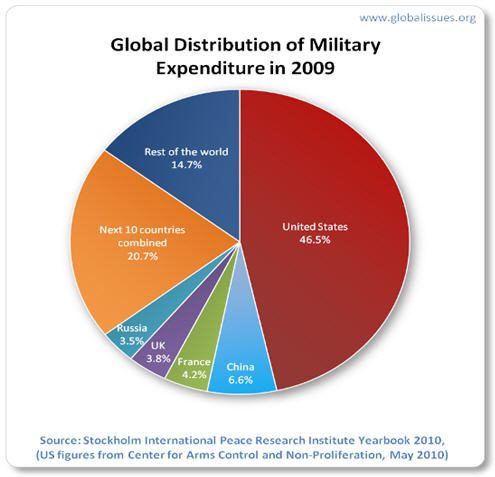
Ladies and Gentlemen, Your Republican FronTrunner... "This is America's moment. We should embrace the challenge, not shrink from it, not crawl into an isolationist shell, not wave the white flag of surrender, nor give in to those who assert America's moment has passed. That is utter nonsense. This century must be an American century. In an American century, America has the strongest economy and the strongest military in the world. God did not create this country to be a nation of followers. America is not destined to be one of several equally balanced global powers. America must lead the world, or someone else will......As President, on Day One, I will focus on rebuilding America’s economy. I will reverse President Obama’s massive defense cuts. Time and again, we have seen that attempts to balance the budget by weakening our military only lead to a far higher price, not only in treasure, but in blood." More defense spending? Apparently we're not spending enough...
I became a Mac user very early on (the mid-'80s). I was attracted – as most are – to their relative ease of use, and intuitive nature of the graphical interface. I've co-authored and edited books on Macs, and spent countless hours composing, developing and maintaining this blog, and interacting all over the web. Clearly Steve Jobs was brilliant, and there have been many excellent tributes written already. The one that touched me was written by one of the smartest Apple observers around – John Gruber. Here it is: After the WWDC keynote four months ago, I saw Steve, up close. He looked old. Not old in a way that could be measured in years or even decades, but impossibly old. Not tired, but weary; not ill or unwell, but rather, somehow, ancient. But not his eyes. His eyes were young and bright, their weapons-grade intensity intact. His sweater was well-worn, his jeans frayed at the cuffs. But the thing that struck me were his shoes, those famous gray New Balance 991s. They too were well-worn. But also this: fresh bright green grass stains all over the heels. Those grass stains filled my mind with questions. How did he get them? When? They looked fresh, two, three days old, at the most. Apple keynote preparation is notoriously and unsurprisingly intense. But not so intense, those stains suggested, as to consume the entirety of Jobs’s days. There is no grass in Moscone West. Surely, my mind raced, surely he has more than one pair of those shoes. He could afford to buy the factory that made them. Why wear this grass-stained pair for the keynote, a rare and immeasurably high-profile public appearance? My guess: he didn’t notice, didn’t care. One of Jobs’s many gifts was that he knew what to give a shit about. He knew how to focus and prioritize his time and attention. Grass stains on his sneakers didn’t make the cut. Late last night, long hours after the news broke that he was gone, my thoughts returned to those grass stains on his shoes back in June. I realize only now why they caught my eye. Those grass stained sneakers were the product of limited time, well spent. And so the story I’ve told myself is this: I like to think that in the run-up to his final keynote, Steve made time for a long, peaceful walk. Somewhere beautiful, where there are no footpaths and the grass grows thick. Hand-in-hand with his wife and family, the sun warm on their backs, smiles on their faces, love in their hearts, at peace with their fate. Gruber's blog, Daring Fireball
Due Process-Free Assassinations By Our Government Ding dong Awlaki’s dead, says the government. While everyone’s talking about having “got” this latest bogeyman, I just wanted to remind folks the kind of language the Administration used to explain why it could kill an American citizen with no due process. Accordingly, although it would not be appropriate to make a comprehensive statement as to the circumstances in which he might lawfully do so, it is sufficient to note that, consistent with the AUMF, and other applicable law, including the inherent right to self-defense, the President is authorized to use necessary and appropriate force against AQAP operational leaders, in compliance with applicable domestic and international legal requirements, including the laws of war. [my emphasis] As to the actual evidence that Anwar al-Awlaki was a terrorist? That’s a state secret. Incidentally, last week the 9th Circuit said there should be some due process and proof of probable cause before the government acts on claims that someone or something (in this case, al-Haramain) is a terrorist. Lucky for the government they managed to kill Awlaki before anyone asked again for due process for him. more from Glenn Greenwald on this outrage outrageutr UPDATE: more from Marcy Wheeler, Michael Ratner in The Guardian, and The Rude Pundit
The Dangerous Cult of the Guardian There could be no better proof of the revolution – care of the internet – occurring in the accessibility of information and informed commentary than the reaction of our mainstream, corporate media. For the first time, Western publics – or at least those who can afford a computer – have a way to bypass the gatekeepers of our democracies. Data our leaders once kept tightly under wraps can now be easily searched for, as can the analyses of those not paid to turn a blind eye to the constant and compelling evidence of Western hypocrisy. Wikileaks, in particular, has rapidly eroded the traditional hierarchical systems of information dissemination. The media – at least the supposedly leftwing component of it – should be cheering on this revolution, if not directly enabling it. And yet, mostly they are trying to co-opt, tame or subvert it. Indeed, progressive broadcasters and writers increasingly use their platforms in the mainstream to discredit and ridicule the harbingers of the new age. A good case study is the Guardian, considered the most leftwing newspaper in Britain and rapidly acquiring cult status in the United States, where many readers tend to assume they are getting access through its pages to unvarnished truth and the full range of critical thinking on the left. Certainly, the Guardian includes some fine reporting and occasionally insightful commentary. Possibly because it is farther from the heart of empire, it is able to provide a partial antidote to the craven coverage of the corporate-owned media in the US. Nonetheless, it would be unwise to believe that the Guardian is therefore a free market in progressive or dissident ideas on the left. In fact, quite the contrary: the paper strictly polices what can be said and who can say it in its pages, for cynical reasons we shall come to. read Jonathan Cook's full, revealing piece at Counterpunch
high-fructose corn syrup: mounting – and damning – Evidence A Princeton University research team has demonstrated that all sweeteners are not equal when it comes to weight gain: Rats with access to high-fructose corn syrup gained significantly more weight than those with access to table sugar, even when their overall caloric intake was the same. In addition to causing significant weight gain in lab animals, long-term consumption of high-fructose corn syrup also led to abnormal increases in body fat, especially in the abdomen, and a rise in circulating blood fats called triglycerides. The researchers say the work sheds light on the factors contributing to obesity trends in the United States. "Some people have claimed that high-fructose corn syrup is no different than other sweeteners when it comes to weight gain and obesity, but our results make it clear that this just isn't true, at least under the conditions of our tests," said psychology professor Bart Hoebel, who specializes in the neuroscience of appetite, weight and sugar addiction. "When rats are drinking high-fructose corn syrup at levels well below those in soda pop, they're becoming obese -- every single one, across the board. Even when rats are fed a high-fat diet, you don't see this; they don't all gain extra weight." read the full article
The Secret of the Fibonacci sequence In Trees People see winter as a cold and gloomy time in nature. The days are short. Snow blankets the ground. Lakes and ponds freeze, and animals scurry to burrows to wait for spring. The rainbow of red, yellow and orange autumn leaves has been blown away by the wind turning trees into black skeletons that stretch bony fingers of branches into the sky. It seems like nature has disappeared. The branches seemed to have a spiral pattern that reached up into the sky. I had a hunch that the trees had a secret to tell about this shape. Investigating this secret led me on an expedition from the Catskill Mountains to the ancient Sanskrit poetry of India; from the 13th-century streets of Pisa, Italy, and a mysterious mathematical formula called the "divine number" to an 18th-century naturalist who saw this mathematical formula in nature; and, finally, to experimenting with the trees in my own backyard. My investigation asked the question of whether there is a secret formula in tree design and whether the purpose of the spiral pattern is to collect sunlight better. After doing research, I put together test tools, experiments and design models to investigate how trees collect sunlight. At the end of my research project, I put the pieces of this natural puzzle together, and I discovered the answer. But the best part was that I discovered a new way to increase the efficiency of solar panels at collecting sunlight! read more about this brilliant 13 year-old's breakthrough
youngblood701 on flickr
• archives
|
|
books
daily reads
film
favorite posts pinter on politicians' language
music
art
archives
|
| ©2005 Tony. All rights reserved. | Website
designed by JSVisuals.com |